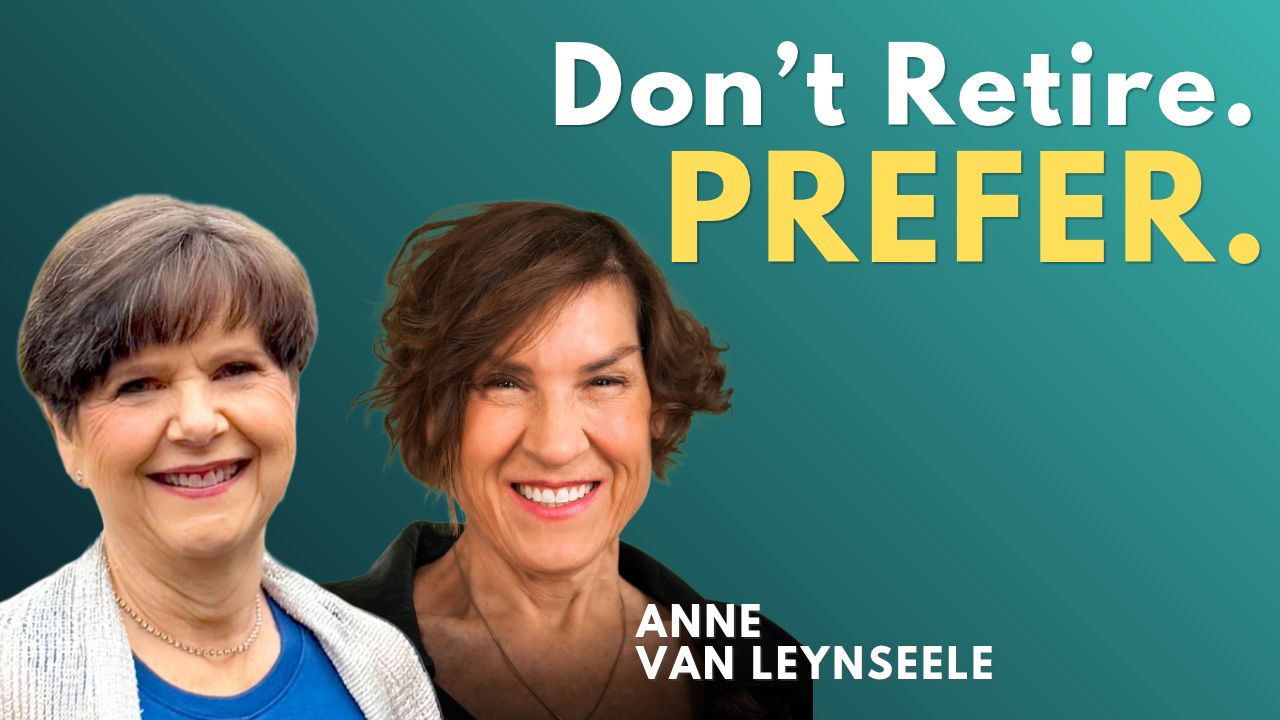
Introducing Anne van Leynseele: Five Career Reinventions and a New Vision for Retirement
GLORIA GRACE RAND: Namaste. My guest today has done something most of us only talk about doing once. She’s reinvented her career five times. Not just once, but five times. Anne van Leynseele has been a Hollywood producer, a Fortune 100 consultant, an attorney, advisor in the Obama administration, a pioneer in cannabis law, and she’s written three books tackling some of society’s biggest problems. And she didn’t just live through reinvention. She studied it. She took everything she has learned about identity risk and starting over and built it into a framework called preferment, which is grounded in neuroscience and sociological research. And her core belief is one that I think every woman in this woman, in this audience needs to hear. The final third of life isn’t a wind down. It’s an invitation.
So today, Ann is going to be here to challenge the way we think about retirement altogether. Why the traditional model doesn’t serve accomplished women in particular, and why real longevity requires challenge rather than rest. And of course, why fear should never be the thing steering how we age. So without further ado, as I like to say, I’m going to bring her up onto the stage and welcome you and to design your life your way.
ANNE VAN LEYNSEELE: Well, hello, Gloria. Good morning. It’s so great talking with you today.
What Reinventing Your Career Five Times Teaches You
GLORIA GRACE RAND: Well, I’m looking forward to this conversation. You, you actually, you’ve reached out to me and in an email and I started reading it going, oh, I like the sound of this. I need to learn more about this lady because I think this is a conversation that’s right up our alley here on the podcast. So I want to dive in a little bit about, you know, we’re going to get to how you came up with this preferment, but I would love to talk about a little bit about the fact that you’ve reinvented yourself five times. I mean, that’s more than most people do, for sure. And most women, although in a way sometimes we kind of do that, especially if you become like a mother and a career woman. But what did, what did all of those reinventions teach you that maybe you couldn’t have learned some other way?
ANNE VAN LEYNSEELE: Well, the biggest lesson I learned is that I’m a person who thrives on steep learning curves. Once I figure something out, I tend to think, well, okay, this is kind of dull now. So I look for the next frontier and challenge myself to successfully achieve. And so that has led to the reinvention. And what I learned along the way is that things really are more tied to each other. When I talk about the fact that I worked in The Los Angeles entertainment industry. And then I got into digital media and then I decided law was next. And from law I got into writing, you know, writing books and I decided on my retirement plan and wrote the book in three weeks. So it really was so organic. But the thread through all of that is that I love research and I love storytelling through all those careers. That is sort of the forefront.
Choosing Every Career Change on Purpose
GLORIA GRACE RAND: That’s interesting and I think it is good that you were able to sort of figure out that there is like a, a thread that kind of weaves through it. Because at first blush it does. Does sound like, it seems like, you know, a little counterintuitive that there would be something connecting all of those different things. Now we’re. Were some of those or were all of those maybe or maybe just some of those. Were they your choice to move into it or were you some sometimes sort of forced into the changing gears as, as I know, I know I have at one point where can. And I think a lot, sometimes a lot of people do find that way. It’s like, okay, well I’ve been doing, now I’ve got to, I’ve been downsized. So now what else am I going to do?
ANNE VAN LEYNSEELE: Well, no, I decided at 16 that I wanted to be child free and husband free for my whole life. And it was the absolute right choice for me. I love other people’s kids, but I knew that I wanted to be able to free, to be free completely, to make my own choices that were based on my needs exclusively. And when you’re sharing a life with someone, you do, you do compromise and you do negotiate and you do blend your needs. So no, the beauty of my trajectory was that when I conquered, I was on the bleeding edge of most of these industries. I lived in Los Angeles in the entertainment industry. I lived through the MBAs taking over Hollywood. It went from making movies to making money. And I kind of rode that, that wave and watch that transition and then sold my company and left. I saw that digital media was coming and I took a, I took a degree in that area and commuter computer animation and multimedia. And I in school decided where I wanted to work and I got an amazing job as the head of production for digital media for an events company.
So no, my moves were all very calculated, very intended and very much planned for.
Why Lifelong Learning Keeps Us Vital After 50
GLORIA GRACE RAND: Well, that’s, I like that that you were able to do that. And it’s, I imagine it’s, it’s a little bit more helpful in a way because possibly even though there’s still stress of learn being into some New environment of. But at least it was something of your choice that you were, you were, you were choosing to embark on this. And so I think that that makes it a little bit easier. And then now you’re just dealing with the normal stresses of learning something new. And as you said at the beginning, you know that, that you’re, you’re very interested in learning things. And I know for me, and I, and I, and I know, I, I’ve heard this elsewhere. I think that the, one of the keys of us being able to. I think helping us even to live longer is the fact that, that if we can continue learning, you know, make, make life about learning something new, always challenging yourself, which I know we’re gonna, we’re gonna get to that a little bit more in a second.
I’m, I’m, I’m, I’m jumping the gun here. But it just occurred to me, you know, I think, I think that’s an important thing is that we have to keep learning. So, so let’s get to that a little bit. I want to, I want to start talking about this preferment. So I would love to know first off where that name came from. I kind of have an idea now just from, from talking to you a little bit, but calling it preferment as an alternative to retirement. And, and so, yeah, so talk about that first. And then I, then I want to talk about a little bit about how that’s different from the traditional retirement model.
What Is Preferment? A New Alternative to Retirement
ANNE VAN LEYNSEELE: Sure. I love talking about this because a lot of people assume one meaning, but I developed it around… Preferment is a 15th century word that means two things. It means a promotion or an ascension to a higher position. And it also refers to dough starters like sourdough.
GLORIA GRACE RAND: Oh, okay.
ANNE VAN LEYNSEELE: Pre-ferment.
GLORIA GRACE RAND: Oh, okay. Oh, I gotcha.
ANNE VAN LEYNSEELE: Yes. So my, my definition is preferment. And so hit the nail on the head that when I came to the word which is very seldom used in the context I’m using it contemporarily, I just, I, it was like a lightning bolt. It was like, oh my goodness. My, my, my concept, the principles I’ve developed, the, the personal milestones that I created that should that have a place for high achieving individuals after they leave their career has a very appropriate name now. It was very exciting moment.
Why the Traditional Retirement Model Doesn’t Fit Accomplished Women
GLORIA GRACE RAND: Well, what I was thinking. And now maybe you can tell me if this is totally off base, but to me, because again, I was thinking of it as prefer, like you’re finding something to do that you prefer to do as opposed to just, you know, rest and relaxation, playing golf. Or, you know, whatever that traditional model of it is. So let me, let’s, let’s dive into that part of this a little bit because then I definitely want to go and have you really dig into what, what preferment really looks like for women. So why do you think that like, or, you know, this traditional model of retirement that it especially doesn’t fit accomplished woman?
How Retirement Was Designed in 1935, and Why It No Longer Works
ANNE VAN LEYNSEELE: Well, I spent four years at the Social Security Administration as an attorney advisor under the Obama, under President Obama. And every day I was inundated with the messaging of what retirement really is. And it was created in 1935 in the, I mean, it was adopted more in the United States. It existed prior in Europe, but it was really formalized in the United States in 1935 as a finance along with a financial Social Security administration. And in doing that, it sort of designated that the money that was being provided for people that had reached the age of 65 was to allow them to rest. Because at that time 75 to 79% of labor in the United States was agriculture and blue collar. We’ve flipped those numbers now.
Now it’s that number white collar, intellectual pursuits and hospitality and things of that nature. And we’re really using an equation for needing to rest in our retirement in a society where mostly we don’t, we need to continue the intellectual demands that we had in our career or we age and actually die sooner than we need to.
Why Longevity Requires Challenge, Not Rest
GLORIA GRACE RAND: Well, yeah, that makes, it does make a lot of sense and it is interesting that that really our, our, our culture and, and everything has changed a lot over, over the decades. And, and also the fact I think as well, I mean, is that we’re also generally living a lot longer than back in 1935 when this was first started as well. So then it seemed like, okay, you know, if you’re only going to live till 70 or something, it’s not going to be, you know, you’re not going to be needing to find something else to do that is going to be more productive for you. So I’m trying to think which way do I want to go here? Because there’s, I wanted, I want to talk about or have you talk about a little bit about, well, let’s do it this way.
Where did, how did this idea maybe formulate and as, as a way for women to. Because in particular it seems like you’re really focusing in on women of how, what does this really mean for them and what does it look like? And then I want to get back into, I want to talk about how you came to that
The Blue Zones Big Three: Doing, Thinking, and Feeling
ANNE VAN LEYNSEELE: And terrific. So I’ll reserve the how I came to it story and tell you why this is so important for women is that many of us, many women have been caregivers for most of their lives. I mean, I observed my, my mom and we bought a farm together on the big island of Hawaii. And that was her retirement plan with my father, who died in 2019. And now she’s a single farmer on the, on the farm. And, you know, she’s practicing my part of my retirement plan too. And we bought the farm. We’d never lived on the big island of Hawaii and we’d never farmed. And so it was this wonderful challenge for both of us that, that we chose. And the beauty of it is it demands what I call the big three doing, thinking and feeling, which is the, the blue zone criterion for longevity. And the studies that have been done on these cultures where people are exceeding expectations and living to 100. They’re, they’re engaged three of those things. They physically move every day.
They challenge themselves to think and solve problems and engage in learning, and they are emotionally engaged on many levels. And the reason I am starting with high achieving women or accomplished women is that it’s more devastating. 67% of retirees report depression symptoms. And that just set off huge alarm bells for me way back in 2004, sorry, 2008 and 2009, when I started at the Social Security Administration.
The Retirement Depression Statistic That Raised Alarm Bells
GLORIA GRACE RAND: Wow. Yeah, that’s not a great statistic at all. I’m just making notes, but because it’s like, holy moly. Because I want to go back in and because not only do I do this as an audio podcast, but as a video. So I’m going to highlight that information because I think that, you know, we need to be aware of that. And so, so. Where, how does neuroscience and identity research fit into this? So, so in your. Or maybe actually before we even get into that. So how did you, how did you actually decide that you, you. Because in fact, you even have, like, I think you have a book or something that you wrote about this as well.
Right. So how did you come up with, with this idea? Was it, was it for yourself or were you doing as you. I mean, you did mention that you were, you know, seeing this, seeing the people coming into the Social Security Administration. Was that sort of the, really the, the generator then for you to kind of do some more research into this?
How Anne Discovered Preferment: A Near-Death Experience and a Farm in Hawaii
ANNE VAN LEYNSEELE: Well, it, it kind of fueled the flame. But I had a near death experience in Australia. I lived in Sydney, Australia for a couple years in 2000, 1999 and 2000 and I had an emergency back surgery after I dove off a boat on in Fiji. I pulled up and injured my back and had surgery and they overdosed me on morphine. I was in my room and the call light buzzed on. But I was. I was not. It was not me. My angel must have pushed it. After that, I really looked at, okay, I’m a single person. I need to consider my retirement much more carefully than someone that has a spouse or, and, or to help with their caregiving. And so it started me thinking about it. And in Australia, there’s a beautiful little beach community. And I thought that’s a good place to start with, is living somewhere where I can be outside in warmer weather and active into my later years. Then fast forward to years after I went back to school, got my law degree, and joined the administration.
And I had these discoveries about some terrible studies about retirees and how when Social Security started, the average men lived to 61 and women died at 65. So it was brilliant piece of legislation because the money going out would not be due for many decades until people were living longer. So now we’re looking at what can be 30 to 40 years after retirement. So that is a significant period of time to fill. And that’s when I got inspired about the farm. And that, you know, that was an interesting spin because I know part of what I battled having a desk job is getting enough movement into my day. So those were some of the things that came together. And then it just was a matter of I’m. I’m a lawyer and I love to research, I love to dive into things. My mother was a research sociologist in healthy aging.
So I heard routinely from her when talking with her about her career and what they were accomplishing, some, some cutting edge research on aging and mental cognition, et cetera. So a lot of that fed the flames as well. Well, in 2013, we bought the farm. I was 48 years old, and I started implementing some principles about, you know, how I was going to live my life and making choices.
A Painful Betrayal and Why There’s No Reason to Wait for Retirement
ANNE VAN LEYNSEELE: I had a catastrophic thing happen when I was running a law firm in legal marijuana and my law partner actually stole from the law firm for two years and discovered it after he left the firm. And that really shifted a lot of my thinking. And I thought, okay, this, this isn’t it sparked my first book and it really taught me lessons about prioritizing. There’s no reason to wait for retirement to do what matters. And my life really shifted and I got much more engaged in passion projects, things that I care about. I started doing a lot more pro bono legal work. And that led to the. These principles of my values matching what I did every day. And that really is the core message of the book now just poured out of me. In September of 2024, I sat down and in a matter of four weeks, I had written the entire first draft of Preferment. And there’s.
There’s a picture of me at the farm with my truck doing my farmer and thing.
GLORIA GRACE RAND: I love that. So good.
ANNE VAN LEYNSEELE: Thank you. And the farm, again, it just a way of keeping me honest. And it’s my personal choice. There are, you know, as many ways to live your preferment as there are accomplished women to plan and design their preferment. But the core is really make the decision to take control. And one of the ways I put it is be selfish in a good way.
The Neuroscience of Aging and Rewriting Life’s Milestones After 60
GLORIA GRACE RAND: Yes, absolutely. I love that. I love that. So one thing you mentioned that, or at least I’ve mentioned that this work now is grounded in neuroscience and sociological research. So was there anything that in doing that research that surprised you that you then implemented maybe in, you know, mentioned in the book?
ANNE VAN LEYNSEELE: Well, many things surprised me that this problem had gone unnoticed for so long and that there were so many research projects, including this statistic I gave you earlier of the 65% reporting depression is an NIH study. It’s not, you know, it’s very real. And the, the bigger point that I came to was that the, the, the cognitive impairments and keeping neuroplasticity were so crucial. And I did a deep dive into that area. And what just flabbergasted me is there is. Erik Erickson developed this milestones for personal development. And it starts at age zero and it goes along. And there are chunks of time and expected cognitive development and personality development and interaction with each other and the world. And at 60, the 60 to death was something that was basically decline reminiscing and, and recollecting achievements of life and actually decay and terrible things. And I thought, wait a minute, that’s no longer accurate. Right?
GLORIA GRACE RAND: Yeah.
ANNE VAN LEYNSEELE: Now we have the ability to do so much more. So I wrote actual personal development milestones from 60 on. And I divide that era, from 60 until death into several segments and what can be accomplished and what can be achieved. And it’s interesting to now pair those with the anecdotal experiences of both my mother and some friends and some of her friends and other people that I meet through my brothers. So it’s exciting to see them play out.
Personal Development Milestones for the First Decade After Your Career
GLORIA GRACE RAND: Yeah. So can you give us an example of like, you know, a couple of those different stages.
ANNE VAN LEYNSEELE: Certainly the immediate stage after retiring is really focused on that. Converting that drive, that need for challenge, need for a structure into setting personal goals, understanding again how the personality shift is yours to take charge of. You know, you, everybody says your identity changes when you leave work. Well, yes it does, but it can change for the better if you acknowledge it and take charge, charge of that. You don’t just sort of fall into this, this role of diminishing your identity instead of just saying, I was in finance. You need to find a way to introduce yourself about what you’re doing now. Structure is another critical aspect that occurs in that initial 10 years after leaving your career.
You know, you create a new form of structure. It’s not habit any longer. It is self satisfying. It is, the structure is built around what you wish to achieve. In the three areas, doing, thinking and feeling. And those pillars. I break down further into specific areas.
Loneliness After 50: How to Find Community in Your Next Chapter
GLORIA GRACE RAND: What’s, what’s coming up for me and I’m curious if you’ve, if you talk about this as well. Well, in the book, because I know, I think for, for me, I, I’m finding this and, and even just talking with other women, there’s like this wanting to be in, to be in community, to be able to find other, you know, women to talk to, to be able to, you know, share things. And I think at the same time then there’s also a bit of a challenge because as we get, get older and maybe we are changing careers or we’re, you know, retiring that, you know, and then, you know, life happens and we lose people that we love and now, or we move away, we’re moving to a different area maybe to either be with grandkids or not. And so now we’re like faced with how do I find, you know, new friends. And, and I was talking with a, with a woman that I, I’ve, I’ve known for, I don’t know, maybe a little over a year now or so.
And, and she says, you know, I’m just, I really want to be able to just find like one or two people that I can talk to. I don’t want to necessarily have it, even have a whole group of friends, but I want, you know, one or two people that I can really connect with. What, what have you found in, you know, in this? Because I, because I know there’s like, you know, it’s like have a lot of people or a few people or, or just, just being in community as a part of this preferment time.
ANNE VAN LEYNSEELE: Well, I understand that there are people for whom it’s much more challenging to get themselves out there. It’s not necessarily an intuitive thing, but there are concrete solutions and I would love to offer you a link. I have a newsletter that gives actual solutions on how to do that. But the short answer is, what I find is there are hundreds of thousands of women in the same boat looking for others that they can share.
Lessons from Japan’s Informal Financial Support Groups
ANNE VAN LEYNSEELE: I learned when I traveled to Japan. I did some interviews of some, some people over there that were in retirement which they have a very joyful word about retirement as well. But they have actually financed, they have, they have more sophisticated. They are informal financial support groups. They coalesce around the idea that they all put a very small amount of money into a joint account. That’s for small financial emergencies that occur one month when you had an unexpected household repair or you had some need that was outside, outside your fixed income. And these groups form a social bond because they have to, they have to trust each other that they’re all going to participate, they’re all going to share the benefit.
Now I’m not suggesting that that is something that, that might work for everyone, but I am saying that we need to find some emotional investment into groups where there’s everyone benefits and everybody contributes equally so that that trust, which is what people are actually looking for, they’re looking for a few people they know they can rely on.
GLORIA GRACE RAND: Yeah, absolutely. And as, as you mentioned, you know, not everybody has children or maybe they don’t have children living near them, you know. You know, like for me, in fact I’ve got, you know, one who lives several states away. Another one is living in Europe right now. So, so I’m alone in my apartment with my two cats. So that’s why I, you know, am searching for, you know, opportunities to connect with other people and, and to not to not be alone, even though I enjoy being alone. Yeah. But there, then there’s other times where it’s like, you know, I want to be able to have some fun with other people.
Ways to Be in Community, Even Among Strangers
ANNE VAN LEYNSEELE: Yes, exactly. But there’s also a factor that’s very important and this is a problem that is being addressed for every age in the United States is the loneliness condition. And I know that I also offer a lot of solutions that. I have a 30 day guide for finding Happiness or Finding Joy. I can’t remember the exact title but it’s really fun. It’s an ebook that I’m happy to share a link that people can download for free from your, your site or your Webcast podcast site. It is about how you can be in. In society even if you don’t personally know people there. It still has an intellectual and emotional benefit. And so I really encourage some things. I take a small example from society of recognizing that I just have seen the ads. I haven’t done deeper research, but Citibank has opened Citibank meeting spaces that are free to any Citibank card holder.
It is a societal recognition. We need a place to go where we don’t have to spend money, but we can be with other human beings that are equally challenged in not being alone. There are some more basic things. Most places have senior centers and I have a stigma, but we need to shift that. We need to go into those senior centers and encourage those senior centers to have activities that aren’t just for people with challenged mobility or limited interest aging in the world. It’s happening at all levels too. I recently joined a really interesting initiative that is really. It’s. It’s not a business networking engagement, it’s a social networking engagement and it’s a dinner ever that. That you can RSVP to twice a month and just go and meet new people.
We all didn’t talk about what we did for a living. I mean, we kind of shared that a little bit. Then. Then we moved on to what do you do for fun? What do you consider play?
Why Play Matters at Every Age
ANNE VAN LEYNSEELE: Playing is such an important factor in everything I teach. It just really is important. I mean, one of the intake things that I love doing is a form that says how do you play? And you’d be amazed how many people have a hard time answering those questions.
GLORIA GRACE RAND: I believe it, actually. Yeah, I do. Yeah, it is. It’s so strange because it seems like it was something that when we were kids it was so, so easy to. To do. But for, you know, some reason, we, as we get older, we do find it more challenging. But it’s, it is a worthwhile thing and, and it can be. I, I know what you think, but I think for me it’s. Sometimes it can be even as simple as something you can do yourself is to, you know, dance around your living room. I was doing that the other day. I had music on and I was playing an old album that I hadn’t listened to in probably 40 years.
I was like, oh, I forgot how much I like this. This guy, this, you know, singing songs. And I was like, yeah. So.
ANNE VAN LEYNSEELE: Good for you. Yeah. And some of those little tips on that. 30 days to joy. It’s fun things like go out and take pictures of five trees that you’ve never noticed before. It’s something that simple is setting a little challenge for yourself. And as I said, I did all the homework. It’s all on paper. You can just, just check off the boxes in 30 days. And people are shocked at how little acts, little shifts and how they do things really can make a difference. I love engaging in conversations with people in the produce department of the grocery store. I talk about, oh, have you seen this new variety of apples? I’ll just talk to anybody. But those little connections, connections with people in our world make a difference in their lives as much as our own.
Start with a Smile: Advice for Introverts and Shy Women
GLORIA GRACE RAND: Okay, so I’m going to ask you though, because as, as someone who had to learn how to, to be able to do that, what advice you give a woman who’s like, I can’t go up to somebody in the grocery store and just start talking to them. So what do you say to someone like that who maybe is, you know, a little bit more introverted and, and is a little, little, you know, nervous about that? How, how do you advise them?
ANNE VAN LEYNSEELE: I say start with smiles. You really can’t believe how easy it is to just look at somebody, look them in the eye and give them a big smile. And you know what? Inevitably they will smile back. And that, you know, smiling laughter are two things that actually combat the feelings of loneliness and depression. So I watch stand up comedy. I find that, you know, if I’m feeling a low day or my energy is waning, or I have a, something, a project that I’m sort of stuck on solving the problem. Stand up comedy on, you know, streaming, you know. But the other thing I find really great is, you know, the, the World cup is here in Seattle and is really happening and there are so many watch parties everywhere, you know, find a local event. Farmers markets are happening all over the country.
Go to a farmer’s market, you’ll find that that’s a self selected group of people that are much easier to talk to. You can go to any of the stands at a farmer’s market and ask people what got, what inspired you to grow X, Y and Z. Farmers will talk to anybody about what they grow. I’m a chocolate farmer. I’ll talk to anybody about chocolate.
GLORIA GRACE RAND: And that’s a good point because I, I know there is a local farmer’s market near me and I have. And they don’t just. And there are people, they’re not just selling produce, of course, but they’re selling like hot sauces. And so I, I tried one of one of the, you know, hot sauces that they had, you know, because people usually will have like free samples and you can test these things out and then wound up up, you know, buying them. But that’s, yeah, that’s an excellent idea is to be able to. That and, and I think that’s, that’s one of the things, is to be curious to ask questions because I think that’s a good way of being able to get over your fear rather than just trying to start up a conversation. Just, just be curious instead.
Getting Started: What Preferment Looks Like in Practice
GLORIA GRACE RAND: Can you walk us through what preferment actually looks like in practice? So if someone is, you know, listening to this, what would, what would like her first steps be? What do you recommend?
ANNE VAN LEYNSEELE: Well, I have one person that bought the book and she said, I got through chapter one and it’s already changed my life.
GLORIA GRACE RAND: Oh, wow.
ANNE VAN LEYNSEELE: She had forgotten that she needs to put in a little bit of work to engage in herself and thinking, what can I add to my life right now? She still works, but she wanted to start. And, you know, I started preferment when I was 48 and I’m still not retired. So I, you know, I, I really think that we plan for every major life transition. And so I am really seeking to talk to women that, that haven’t retired. And some of them haven’t retired because they don’t know what it’s going to look like. And so starting to think of what do I need? Where do I want to live? Do. Am I still going to be in.
I’m sorry, my little necklace fell off the. Where do I want to be? What do I want it to look like? Daydream. That’s a first step. But I also want to make sure that people are, are thinking in terms of this is a phase of my life where I am my own boss and I can choose what fills every day, each day. So I don’t know if that exactly answered your question. The preferment process is really a short. I designed it like an elementary school workbook. So it’s fun, it’s easy, it’s, It’s. There’s a short chapter with some, some theory, a little story, and some ideas on why the next what I call challenges. They’re. Each challenge is going to help you get closer to having a complete picture of what your unique preferment looks like.
When Your Next Chapter Doesn’t Fit: Testing Ideas Before You Leave Your Career
GLORIA GRACE RAND: And that’s helpful, Definitely helpful. And I think that’s, that’s. Well, actually, let me, let me ask you this so because I Again, you know, when I, when I first read about, read what you were about, I thought well, this dovetails in so nicely with the premise of my show, which is to design your life your way to, and, and you’ve kind of, we’re just alluding to that. You know, it really is, it’s like figuring out what do you want to do. And, and I like though that you’re also saying is to start now, you know, when you’re like say in your 40s or your 50s, especially if you are still working to start thinking about what, what do you want that next chapter to look like? And well, let me ask you this because I, I, I have an idea. But what would you, well, let me just, let me just say it this way.
If someone has an idea of how it wants, what they want their next chapter to be like, and then they do it and then they find that they don’t like it. So then, you know, as someone who has, you know, reinvented themselves several times. Well, so what would you, what would you say to them? Because I, I, I have an idea of what I would say. But let me, let me hear it from you. What would you recommend to them?
ANNE VAN LEYNSEELE: Well, the interesting thing about starting before you actually leave your career is in that ramp up time you can test a lot of things. And I have a chapter and some exercises, some challenges that focus on expanding on something that maybe takes up a very small part of your life right now, but you want to dive deeper into and I take a very simple example of walking your dog. You may love walking your dog and you may do that, you know, once in the morning and once in the evening, and that may be something you look forward to. But there are people that take that further. They may go to dog parks, they may go join a dog walking group, they may join a class to train their dogs. They may learn how to, or teach their dog how to compete in agility competitions. They may just do one a year that’s local. Or they may turn their entire life around and start traveling all around the country competing at a high level in agility training with their dog. That’s a huge, huge spectrum.
And almost every activity can be expanded in that way. And so if you begin now getting a list of the activities that you really love and writing out how they can expand.
From Lost to Lit Up: Finding the Thread of What You Love
ANNE VAN LEYNSEELE: I worked with a, a former executive from Dell and she, she wound up at my friend, she’s a neighbor of a friend and she wound up at the Mailbox in tears three months after she retired saying, I’m lost, I don’t know what to do. And we worked together and she kept Giving me the expected answers, the same answers she gave her financial planner. And they’re too, they’re too vague, they’re too general. And she finally hopped on an advisory session with me and she said, I said what’d you do this weekend? And she said, oh, I went on some, on a hike with some friends. And I said, oh, where’d you go? And she said we went to this amazing forest and you know, the, the da da da da da. And she just lit up. And I went, sarah, this is your key to unlock.
And she came back to the next session with two and a half pages of ideas that had something that in some way was connected to forests. Right. And that again was on this spectrum from a hiking group to being on the board of a conservatory conservancy organization, non profit to a doing. She found a group where she can go and rehabilitate and clean up trails to group with kids teaching them orienteering so they can follow a trail from a map and a compass to. She found an art group in her community that went to parks in the area and set up their art materials and drew or painted or made music around the trees.
GLORIA GRACE RAND: I love that. Yeah, yeah, it is amazing. And it really just take, taking, take some time to do some brainstorming like that. And of course there’s even tools out there, you know, you can even use. AI could probably come in handy for you helping at the very least Google for like, you know, what’s, what other things are involved with this thing that I’d like to do. What would be some related activities or something. Just especially even just to maybe spark your own ideas. Because once you, once I do, I know, I found that it’s like once you start sort of making lists, it’s amazing. More ideas will start to come to you. And you can also enlist a friend as well to help you brainstorm because when the, when two or more people get together, it’s amazing the brain power that can be put to use that way.
A Caution About Ageist AI and Search Results
ANNE VAN LEYNSEELE: Yes. I love that suggestion. I just want to caution you that most search engines and most AI are very ageist.
GLORIA GRACE RAND: That’s true too. Yeah, you’re right.
ANNE VAN LEYNSEELE: What should I do in retirement? Yeah, yeah. What you’re gonna get is water, coloring, paint, you know, you know, just things that, fishing, golf. So I say, you know, what are some unusual, you know, I, I just think you, you be careful of your prompt.
GLORIA GRACE RAND: That’s true.
ANNE VAN LEYNSEELE: You can wind up with very age and you know what they consider age appropriate activities.
GLORIA GRACE RAND: Exactly. Yeah. We shouldn’t be limiting ourselves that way.
ANNE VAN LEYNSEELE: Oh, absolutely.
Finding Your People: AARP’s Ethel Groups and Why Women Lean In
GLORIA GRACE RAND: And, and for, for folks who are listening to this who are in the United States, I want to just have a shout out for. I, I get the AARP magazine and I’ve, I found out that they have a group for women. It’s called the Ethel group. And on Facebook there is an Ethel group that you can join. And then they also have local groups in your community. So I belong to one that’s for Central Florida and a bunch. Someone there, you know, created an event to go to lunch. And so I went to lunch the other day with about 10 other ladies. Yeah, we had a lovely time getting to, getting to know me. You know, I met some new people, so there are opportunities, there are places for you to be able to learn to connect with, with people out there.
ANNE VAN LEYNSEELE: Yes. And I have never been able to reconcile. And earlier you asked why I focus on women and I. Over the, the years that I’ve been in unofficially and then officially advising people, what baffles me is men come in mostly because of their children. They’re. Most of their adult children are bringing them to my doorstep, saying, my dad’s lonely and miserable. What do I do? And the problem is they start the conversation with, I’m bored. And they won’t even engage in reading the book. So I kind of said, I love you guys. I love men. You know, I can’t. I can lead a horse to water. Right. Women are engaged. They get that they’re going to have to put a little bit of effort and maybe step out of their comfort zone a little bit to reap the, the huge rewards that are out there. But I just remind everybody, we’re all in the same boat. We’re all trying to figure out how to meet our emotional need. We have a human need. It’s.
It’s as essential as air and water to belong, to matter to people. We need to know that there are people out there that care what happens to us.
Where to Find Anne and Her Book, Preferment
GLORIA GRACE RAND: Yes. So. So good. So good. Oh, my gosh. We could, we can just keep.
ANNE VAN LEYNSEELE: Yeah.
GLORIA GRACE RAND: Keep talking for ages and ages. And I know I. And I feel like in a way we’ve also just scratched the surface. But, but it’s okay. You know what? Because I want to have people connect with you and where. And then hopefully we’ll. We’ll talk after. So I want to get some of those links so I can put them in the show notes for, for folks, for those resources that you mentioned. But, but at least as a starting place, where is the best place for people to find out about you and. And. And hopefully probably get the book too, I imagine.
ANNE VAN LEYNSEELE: Well, it’s on Amazon and several other booksellers. It’s called Preferment. Right. What the cover looks like. Hard to forget blue skies. And the the logo is. It’s not very done here. It’s a little. It’s a little person with a bluebird of happiness. So I. And then the. My website is rarefied R-A R-I F I E-D Life L I F E dot com.
GLORIA GRACE RAND: I love that. What’d you come up with a name for that?
ANNE VAN LEYNSEELE: Well, that we. We should be saying no more often to things that we feel are obligations throughout our lives.
GLORIA GRACE RAND: I like that. Okay.
A Life Lived on “Yes, And”
ANNE VAN LEYNSEELE: Yeah. I did in. I started doing improv when I was. I was 10 years old. My mom, we’d moved to a new place and my mom, with her insight, got me involved in a local community theater at age 10 to, you know, introduce me to other people and, and start, you know, having a social circle. So it was a kids program at a local theater group and we did improv. And that’s when I learned “Yes, and.” My life has been nothing but yes, and. I would rather fail or or make a huge mistake doing, you know, getting engaged with something then regret not doing it.
Closing Thoughts: Make Your Next Chapter the Best One Yet
GLORIA GRACE RAND: Yeah, absolutely. Thank you so much for being here today. We’ve gotten so much, so much good information out there and I. I encourage all of you to. That you’ve been listening to follow up and. And consider preferment instead of retirement or. Because, yeah, you know, you’re. We’re. We can be as young as we choose to be.
ANNE VAN LEYNSEELE: We’re starting a revolution.
GLORIA GRACE RAND: Yes, absolutely. Yeah. And you’re a huge part of it. Thank you so much for your time.
ANNE VAN LEYNSEELE: Oh, thank you.
GLORIA GRACE RAND: And I do want to thank all of you for watching and for listening today and. And definitely check out the show notes. I’ll have some links there for you from Anne. And. Yeah, just know that you can keep challenging yourself and look for. Look for ways that you can make. Make the next chapter of your life the best one yet. So until we meet again next week, I encourage you to go out there today and. And every day and live boldly and on purpose.